By: Kim Jennings, Co-Owner, Green Mountain Floral Supply, Inc.
October 16, 2026
Key Takeaways
- Sustainability goes beyond environmental practices. Sustainabloom’s free Sustainability Planning Template for Wholesale Florists helps businesses consider the environmental, social and economic dimensions of sustainability.
- Understanding where you stand is the first step. The template’s simple red, yellow and green self-assessment helps wholesalers evaluate current practices, identify opportunities for improvement and prioritize actionable changes.
- Small changes can create meaningful impact. From improving recycling and composting practices to reducing everyday waste, practical, incremental improvements can help wholesalers build a more sustainable business over time.
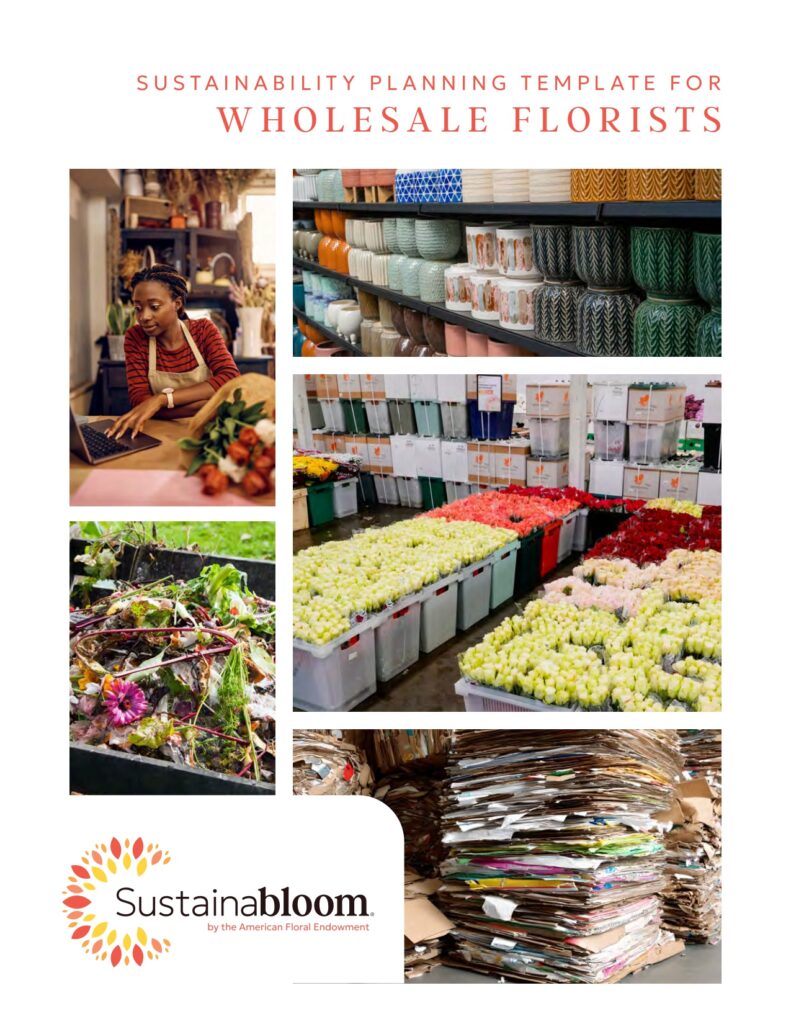
If you value the idea of sustainability and want to incorporate sustainable practices into your wholesale business, there’s no better time to start than now. This year, American Floral Endowment’s Sustainabloom released a free resource titled Sustainability Planning Template for Wholesale Florists. An outstanding document, it not only compiles and delivers sustainability information, but also contains a self-assessment tool for establishing a baseline of where your business falls in the area of sustainability and actionable tasks to move your business forward on its journey of incorporating more sustainable practices.
The Sustainability Planning Template for Wholesale Florists is arguably this year’s most important resource for helping floral wholesalers take meaningful steps toward a more sustainable future.
From an environmental and sustainability standpoint, I feel fortunate to have been raised in Vermont and to have our wholesale floral business based here. Vermont has a long history of environmental activism and Green Up Day is one shining example. Green Up Day, a day dedicated to picking up trash along the state’s roadways, began in 1970 when then-Governor Deane Davis ordered Vermont’s highways closed from 9:00 a.m. to noon, so volunteers could clear the highways of litter. Fifty-six years later, always on the first Saturday of May, Green Up Day continues, with over 25,000 volunteers picking up over 425 tons of trash throughout the state.
This kind of environmental awareness seeped into the foundation of my youth and solidified into a core value as I moved into adulthood. And while I strongly believe each of us has a responsibility to care for the natural resources vital to our existence, I understand that not everyone had the same developmental experiences I did. It’s why I started this article with the sentence, “If you value sustainability,” because my intention is not to try and convince you of the value of sustainability but, rather, to highlight Sustainabloom’s amazing resource if you’re curious about the topic.
Armed with what, I believed, was a keen understanding of sustainability, you can imagine my surprise when the Sustainability Planning Template for Wholesale Florists confronted me with an expanded definition of the word. This was a word I’d known for decades. This was a word tossed around in Vermont’s social circles, long before it entered the vocabulary of the broader public. However, the Sustainability Planning Template forced me to rethink what I knew and acknowledge my previous understanding was narrowly focused on the environmental impacts of the choices we make. The Sustainability Planning Template illuminated that I was blindly ignorant of how the social and economic impacts of our work also play into sustainability.
My education and enlightenment continued. The next part of the document contained a “stoplight” assessment tool, so named for the simple red, yellow, and green light system used to help categorize the sustainability practices already taking place within our business. For example, in the “Flowers” category, one discussion point inquires, “How often are counters and tools cleaned?” That earned a red light for our company. In the “Waste Management” category, however, we received green lights for practices such as composting and recycling materials.
Completing the assessment was an educational, informative, and worthwhile exercise. It opened my eyes to areas of sustainability I had never considered. As an example, one discussion point in the Waste Management section inquires whether clearly labeled recycling bins are placed in high-use areas such as bathrooms and design benches. That question prompted our team to take a closer look at the waste generated in our bathroom sink area, where we realized a significant portion of the waste consisted of brown paper towels used for drying hands at the sink. Those paper towels are now diverted from our trash and placed in compostable bins.
Recognizing simple opportunities and making these small changes will lead to measurable differences and that’s the point of the Sustainability Planning Template: Don’t try to boil the ocean.
So, whether these are your first steps on the sustainability journey or you’ve been traveling the path for a while, I encourage you to visit the Sustainabloom website and download your free copy of the Sustainability Planning Template for Wholesale Florists. And while you’re at it, consider downloading their similarly named Planning Template for Retail Florists and sharing it with your customers. These resources could single-handedly move the sustainability needle of the floral industry in a positive direction. And that’s good for all of us.
Download Sustainabloom’s Sustainability Planning Templates: https://sustainabloom.org/sustainability-planning-templates
Interested in becoming a WFFSA wholesale member? Learn about membership benefits and submit a membership application: https://wffsa.org/join-wffsa/