
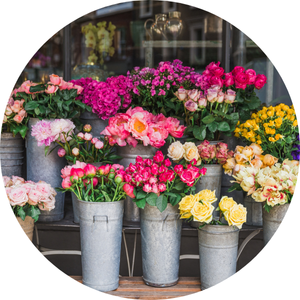
We set out to create a simple weekly growers market in our warehouse. What we got was a front row seat to the hopes, hesitations, and hard truths that define the relationship between growers and wholesalers. It wasn’t perfect, but it taught us more than we expected. This is the story of what worked, what didn’t, and why we’re coming back in 2026.
This past spring, we tried something ambitious, maybe even a little idealistic. We opened our warehouse doors and invited local growers to set up a weekly market: low cost, low pressure, out of the rain, and free from the bureaucracy and expectations that come with traditional farmers markets. Just a clean, well lit space and a simple premise: bring your flowers, meet your customers, build a community.
For the growers, it was meant to provide a centralized hub with steady foot traffic and the chance to connect directly with florists, designers, DIY brides, wholesale buyers, and anyone else who gets a little weak in the knees around fresh cut stems. For us, it was a chance to expand our customer base, strengthen relationships, and stop burning time and margin chasing local product in drips and drabs.
In theory, it was elegant. Practical. A genuine win for everyone.
And that is where reality stepped in.
Very quickly, we discovered how much misunderstanding exists between growers and wholesalers, and how many assumptions people bring into the relationship. There were questions about motives, pricing, sustainability, and whether we actually cared about the same things they did. Some growers viewed wholesalers as the classic middlemen, another link in the chain taking more than they give back. Others framed the floral supply chain as a zero-sum game where it was impossible for small independent growers to exist competitively. It all bubbled up the moment we tried doing something different.
Here is the irony. This kind of suspicion is not unique to our little project. It is lurking in nearly every corner of the floral world. Wholesalers question importers. Importers question freight forwarders. Designers question wholesalers. Grocery chains seem to exist in their own constantly changing universe. It is a big, interconnected system where most people assume the next group in line is out to squeeze them. The truth is usually far less dramatic. In reality, most of us are just trying to do good work, stay afloat, and support the people who rely on us. But that mistrust seems to have distilled itself within the small grower community of our industry to a degree that took us off guard, and that was the landscape we walked into, with everyone waiting to see when the true colors would show.
Yet in spite of that tension, the interest in the program was real. There was genuine excitement at the idea that someone was trying something that did not tilt the table in one direction. Something where small growers could benefit as much as anyone else, and that feeling carried us farther than any spreadsheet ever could.
I won’t pretend the program was a runaway success. Participation was inconsistent. Some weeks, growers brought in incredible, world-class product that made you stop in your tracks. Other weeks, customers wandered the warehouse asking where everyone was. Enthusiasm was high, but commitment was hit or miss. Maybe next week. Already sold out. Great individual outcomes for the growers, but tough when you are trying to build a steady market.
Still, this was not a failure. It was a pilot. A trial run. A chance to see what worked and what would need to change for the idea to really thrive.
What I gained from the process was a renewed appreciation for the grit of local growers who coax beauty out of soil in a region that spends a majority of the year under a light drizzle. Their passion is unmistakable. Their work ethic is something to admire. And I also found myself defending, sometimes more than expected, the role of brick and mortar wholesalers. Not as unnecessary middlemen, but as the connective tissue that keeps this industry functioning. We are the bridge between field and florist, between supply and demand, between idealism and the practical day to day reality of getting flowers where they need to go.
So where does that leave us? Somewhere honest, I think. We learned a lot about communication, expectations, and the emotional terrain local growers navigate every day. We saw flashes of what this market could be: vibrant, reliable, community-driven, and genuinely beneficial for everyone involved, and that alone makes it worth revisiting.
So we will come back to the idea in 2026 with a clearer plan, stronger communication, and a deeper understanding of what growers actually need, not what we assume they need. This year reminded me why this industry is worth the work. It is the people, the passion, the craft, and the belief that beauty deserves space to thrive. I am looking forward to giving this another run, a little smarter and a little more stubborn, because good ideas are worth fighting for, and this one still has enough promise to keep us showing up.
Chris Berglund
Washington Floral Service